


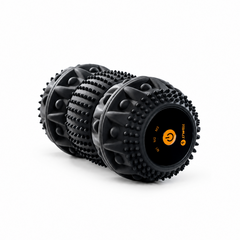
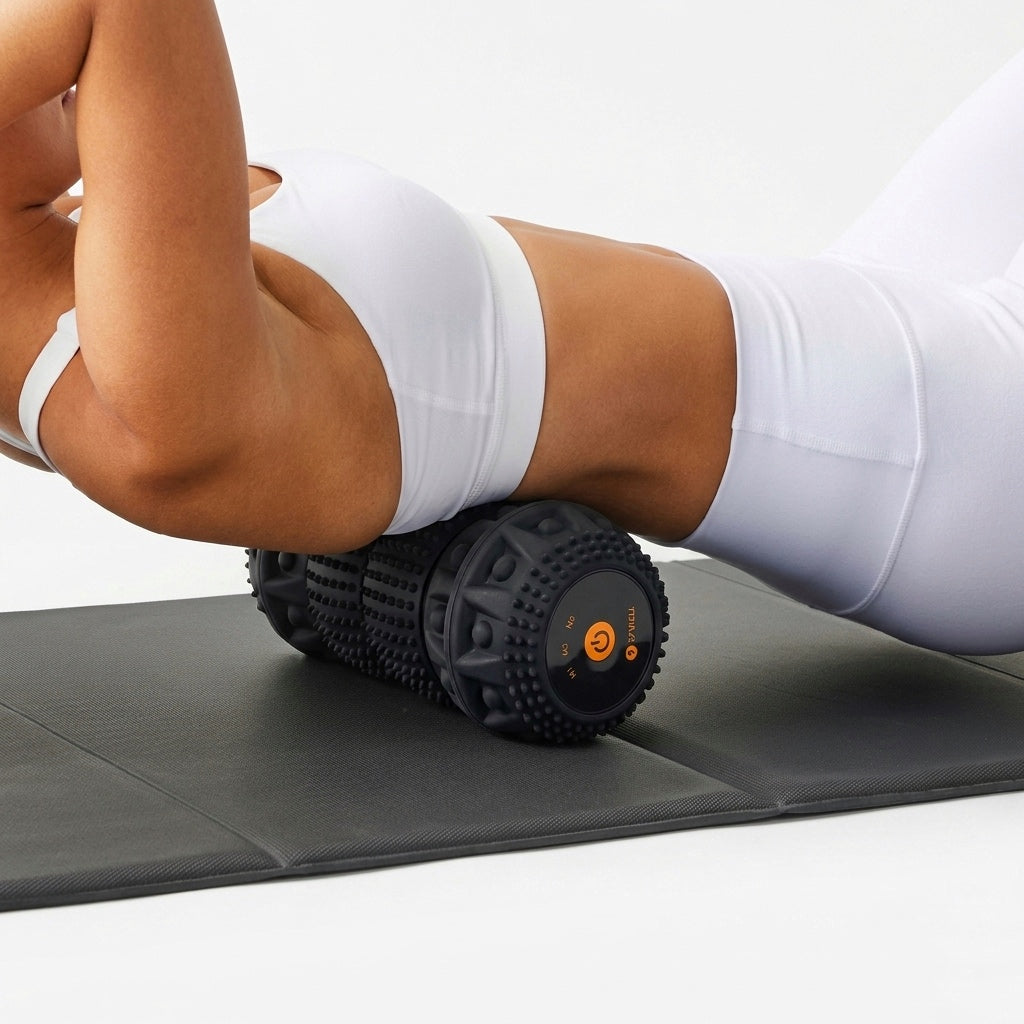


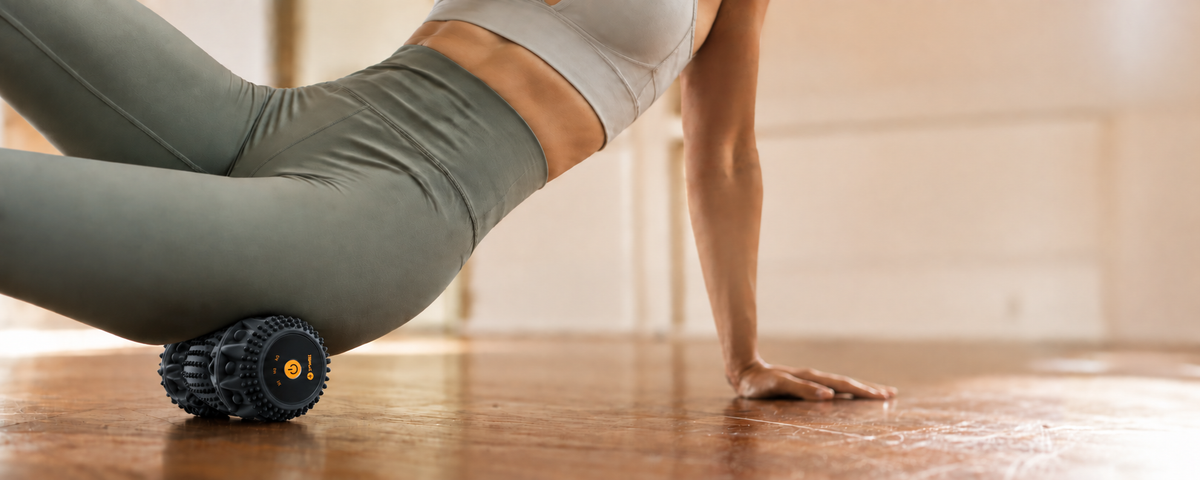
Put a standard foam roller beside a vibrating model. Both give you a rolling surface. Both rely on body position, pressure, and movement. One adds a motor. That single difference is the question most benefit claims need to answer.
Evidence suggests only a narrow set of plausible vibrating foam roller benefits. A session may change short-term range of motion. Some people in small studies report less soreness or fatigue. Adjustable vibration may also make rolling feel more tolerable. Across the outcomes studied, however, current research does not establish a consistent, meaningful acute bonus over the same rolling without vibration, and it does not prove that muscle repairs faster.
Before accepting a benefit claim, ask three things: Which outcome changed? What was it compared with? How long did the change last? Those questions turn a vague promise into something you can judge.
The Motor Adds One Variable, Not a New Recovery Category
With an ordinary foam roller, you control the contact by shifting your weight and moving over the cylinder. The surface presses and rolls against the selected muscle area. A vibrating roller keeps those inputs and adds repeated oscillation.
The vibration may change the sensation immediately. It can make a familiar pressure feel busier, stronger, or simply different. It also creates another variable for researchers and users: vibration frequency and intensity. But switching on the motor does not separate vibration from the pressure, friction, movement, body area, and time already involved in rolling.
That matters because a different feeling is not automatically a different biological result. If a powered roller feels more comfortable, that can be a legitimate personal reason to prefer it. It is not proof that the device is increasing circulation, changing fascia, repairing tissue, or producing a deeper result.
The same distinction protects against the opposite mistake. Uncertain evidence does not mean vibration does nothing. It means the extra contribution of the motor is harder to identify than a product demonstration may suggest.
A Benefit Needs an Outcome and a Comparison
“It helps recovery” is too broad to evaluate. Range of motion, soreness ratings, blood-flow measures, muscle damage, and athletic performance are different outcomes. A positive result for one does not establish the others.
Short-term range of motion
Range of motion is the most defensible place to look for a possible short-term effect. Some studies have found that a joint moves farther after vibration rolling. The more difficult question is whether the motor deserves the credit or whether rolling itself explains much of the change.
A 2025 systematic review and multilevel meta-analysis examined vibration added to several flexibility methods. Vibration often looked helpful against a passive control. In the acute vibrating-foam-rolling subgroup, however, adding vibration did not produce a meaningful pooled advantage over the same rolling without vibration. The more favorable longer-term VFR subgroup was based on only two studies, leaving too little evidence for a confident general rule.
The useful conclusion is modest: vibration rolling may be one way to support a short-term mobility session, but research does not show that every powered roller will improve range of motion more than a regular one. An immediate measurement also says nothing by itself about permanent flexibility or injury prevention.
Soreness, fatigue, and pressure tolerance
This group of outcomes can sound more conclusive than it is. A person may rate soreness lower, report less fatigue, or tolerate more pressure after rolling. Those changes can matter to how the session feels. They do not show how quickly the muscle repaired.
A 2025 review focused on vibration rolling after muscle fatigue found potentially favorable results for delayed-onset soreness, pressure-pain threshold, subjective fatigue, and range of motion in selected joints. Yet the review included only eight heterogeneous studies, and the findings were not consistent across outcomes. Its authors also noted that the effects of vibration were difficult to isolate from the pressure and friction of rolling.
Pressure-pain threshold deserves especially careful wording. It measures how much pressure a participant tolerates before reporting discomfort. A higher threshold may describe a temporary change in perception. It is not evidence that an injury was treated, inflammation fell, or damaged tissue healed faster.
Blood flow, recovery, and performance
Blood flow is a common bridge from “this feels warm” to “this improves recovery,” but that bridge is not secure. Physiological findings in the reviewed vibration-rolling studies were inconsistent, including measures related to blood flow and muscle oxygen. Head-to-head evidence does not establish that turning on vibration creates a reliably larger or longer-lasting circulation effect than ordinary rolling.
The evidence also does not support buying a vibrating roller for a dependable boost in strength, jumping, balance, or athletic performance. Nor does it establish faster tissue repair, lower inflammation, injury prevention, or rehabilitation. Those claims require their own outcomes and comparisons; they cannot be inferred from a short-term mobility change or a lower soreness score.
Why Standard Rolling Changes the Answer
A study can ask at least three different questions, and each produces a different kind of answer.
- Comparing vibration rolling with rest tests the whole powered-rolling session against doing nothing.
- Comparing it with ordinary rolling is the cleaner test of what the motor adds.
- Comparing it with stretching or another activity helps choose between routines, but it may not isolate vibration.
This explains why research headlines can appear to disagree. A powered roller may perform better than a passive control. The same roller may show little measurable advantage over a regular roller. Both statements can be true.
Protocols also vary. Researchers use different muscle groups, session lengths, vibration frequencies, roller designs, and outcome timings. One study may measure hip motion immediately after rolling; another may track soreness after exercise. Pooling those results can help reveal a pattern, but it cannot turn every model and mode into the same intervention.
Standard rolling may already provide much of the input associated with the observed change. That does not remove every practical reason to add a motor. It changes the buying question from “Does vibration speed recovery?” to “Does adjustable vibration make this kind of rolling more comfortable or usable for me?”
An Immediate Response Is Not a Long-Term Result
Most useful findings in this area are acute or short-term. A measurement taken immediately after a session tells you what changed at that moment. It does not show that the same difference will remain tomorrow, accumulate over months, or transfer to a different activity.
The timescale changes the language you should accept:
- A short-term increase in measured range of motion is not permanent mobility.
- Less perceived soreness is not less muscle damage.
- A higher pressure-pain threshold is not pain treatment.
- A warm sensation is not proof of improved circulation or faster repair.
The device match matters, too. A research protocol may specify a vibration frequency, session length, body area, and rolling cadence. Unless a consumer model publishes comparable information and has been tested in that protocol, the study cannot verify a result for that model.
This is why “research-backed technology” is not enough. The relevant questions are which research, which outcome, which comparison, which timescale, and whether the product was actually studied.
Settings Change the Experience, Not the Evidence
Controls can still be useful. Multiple modes let you adjust the sensation. You do not have to accept one fixed intensity. That is a practical feature, especially if your aim is to start mild and find a comfortable level rather than chase the strongest setting.
For example, the manufacturer’s current RECOVERO ROLL modes and instructions list M1 Low, M2 Medium, M3 High, and an AUTO sequence. Those options document how the product can be adjusted. The public page does not list a numerical vibration frequency, vibration amplitude, or independent model-level outcome testing. As a result, none of its modes can be mapped to the studies above or called proven to improve range of motion, soreness, blood flow, or recovery.
That evidence gap does not show that the roller performs poorly. It shows that configuration and outcome proof are different things. A shopper can value adjustable modes without turning those modes into a clinical or physiological promise.
Use the settings as controls, not goals. Start with a mild sensation and follow the current instructions. Keep rolling on muscle rather than directly over the spine, joints, or other bony areas, and avoid bruised, swollen, or injured areas. Stop if the session causes pain or unusual discomfort. If an injury or health condition makes self-use uncertain, seek individualized guidance from a qualified healthcare professional.
When the Extra Motor Earns Its Place
A vibrating roller can be a sensible upgrade when the vibration changes the experience in a useful way. Perhaps a lower setting makes broad rolling easier to tolerate. Perhaps having several modes helps you keep pressure comfortable. If that difference makes you more willing to use the roller, the motor has a practical job even without a proven recovery advantage.
A standard roller may be the better fit when simple broad pressure already feels comfortable. It has no battery to charge, no motor noise, and no powered settings to manage. If those differences matter more than adjustable sensation, vibration may add complexity without solving a problem.
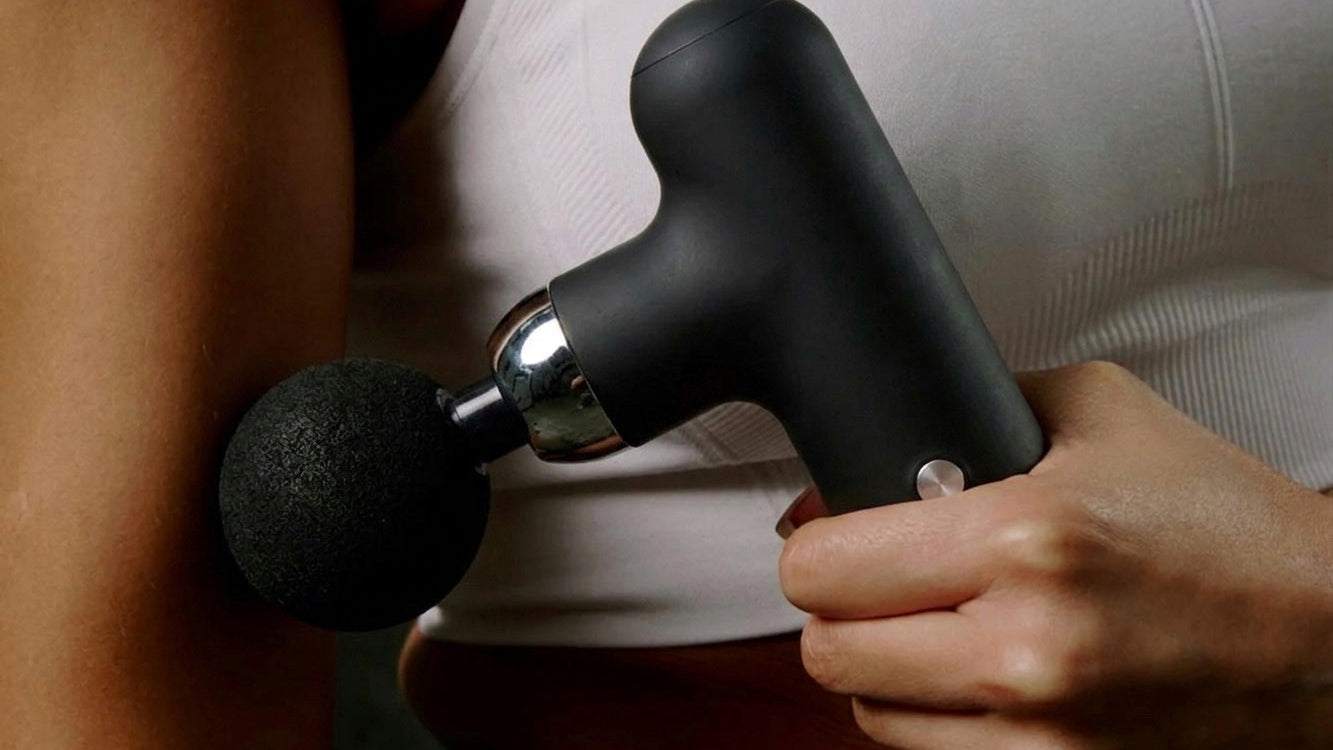
The shape of the job also matters. A roller suits broad contact over larger muscle areas. If you actually want small-area, handheld percussion, it is more useful to compare broad rolling with targeted percussion than to ask a vibrating roller to behave like a massage gun.
Do not use the highest mode as a test of quality. Research has not established one optimal vibration dose, and more intense does not automatically mean more effective. A useful setting stays comfortable and controllable under the device instructions.
Return to the original comparison. If “better” means a more adjustable or tolerable rolling experience for you, the motor may earn its place. If it means reliably repairing muscle faster than a standard roller, the evidence is not there. That narrower distinction is the honest way to understand vibrating foam roller benefits—and to decide whether you need the vibration at all.


Hinterlasse einen Kommentar
Diese Website ist durch hCaptcha geschützt und es gelten die allgemeinen Geschäftsbedingungen und Datenschutzbestimmungen von hCaptcha.