


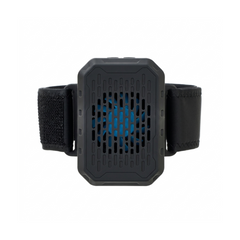


You finish your workout with a damp towel, a half-empty bottle, and shoes that need their own compartment. The last thing you want is another gadget to sort out. A massage gun may look compact on a product page, yet still end up buried, discharged, or unused at the bottom of your bag.
A pocket massage gun earns gym-bag space only when the complete setup is easy to carry, protect, use for a defined job, clean, dry, and repack. Smallness alone does not settle that question. The useful test is whether the tool survives the whole routine with little enough friction that you will reach for it again next week.
Pocket-Sized Is a Use Claim, Not a Measurement
“Pocket,” “mini,” and “compact” do not describe universal size classes. One brand may mean the device fits in a hand. Another may mean it occupies less space than a larger model. Neither label tells you how the complete setup fits beside the gear you already carry.
Start by defining the packed object. Depending on your routine, that may include:
- the powered device;
- the head you plan to use;
- a protective pouch or bag; and
- a charging item, but only when you need it that day.
That is the footprint to evaluate. Measure the device and the packed kit when numeric dimensions are available. Then test them against your bag while the bag contains your normal shoes, bottle, towel, clothing, straps, and small accessories. An empty side pocket can give a false sense of space.
The same distinction matters when you read product copy. A manufacturer's “pocket-sized” description is qualitative positioning unless the page also provides dimensions and weight. It may be a useful signal that the product was designed with portability in mind. It is not proof that the device fits a clothing pocket, your preferred compartment, or every gym bag.
Pack for One Workout, Not Every Possible Muscle
A four-head kit does not require a four-head gym loadout. Before packing, name the single job you expect the tool to have around that session. Then use the current manual to select the head intended for that area and type of use.
That creates a minimum viable loadout:
- The device. Confirm that it has enough charge for your planned use rather than carrying a cable by default.
- One appropriate head. Bring the attachment selected for the job you named. Keep the other options at home.
- Protective storage. Use the supplied storage solution or another method permitted by the manufacturer to keep the device and head contained.
- A charging item only when needed. If charging is part of the day, verify the exact connector and input instead of assuming that any USB cable will work.
This approach removes two common failure points. Loose attachments cannot disappear into different compartments, and unused options do not compete with the gear required for the workout. It also makes repacking easier because every carried item has an obvious place.
The current 17Well Mini Massage Gun configuration illustrates the choice. Its product page describes the device as compact and pocket-sized, lists four speeds and four interchangeable heads, and gives a manufacturer maximum of up to 4,000 impacts per minute. The page also lists USB-rechargeable operation, a storage bag, and a user manual.
Those facts describe the available setup; they do not establish the ideal gym loadout. A practical user can choose one of the four heads for the planned session and leave the rest at home. The page does not currently publish numeric device or packed dimensions and weight, battery capacity or runtime, charging time, or a clearly resolved connector specification in the visible product details. Check those points if any one of them decides whether the kit fits your routine.
Give the Device a Fixed Route Through Your Session
A gym-bag massage gun needs a fixed home, not whichever gap remains after you pack. Choose a compartment or protected pouch that you can reach without removing half the bag. If retrieval requires moving shoes, clothes, and a bottle onto a locker-room bench, the tool is likely to stay packed.
Run four checks before giving it that location.
Keep it away from impact. Do not let loose locks, metal accessories, or other hard items strike the device or its controls. A soft pouch can organize the kit, but it does not automatically prove impact protection. Follow the storage guidance for the specific model.
Separate it from liquids and damp gear. A closed bottle can still leak, and used clothing can transfer moisture to nearby items. Unless the manufacturer publishes a suitable resistance rating and care method, do not assume the device tolerates sweat, spray, or a wet compartment.
Confirm the power state. Switch the device fully off before it returns to the bag. Some products use a long press for power. That control should not be called a lock unless the manufacturer documents a separate locking function or protection against unintended activation. For example, 17Well lists an approximately 1.5-second long-press control; that fact alone does not prove the device cannot start when packed.
Check the room, not just the decibel number. Shared-space suitability depends on the setting, the people nearby, and gym rules. 17Well lists a 25–45 dB operating range, but this is a manufacturer specification rather than an independent locker-room test. Even a device marketed as quiet can be intrusive in a calm stretching area. Use headphones for your own audio, not as a reason to ignore the sound others hear.
The route should remain the same each session: retrieve from one place, use in an appropriate area, switch off, reset the contact parts, and return every item to its assigned spot. A stable route gives the portability claim a practical test.
Use It for a Defined Job, Not a Performance Promise
Being easy to carry does not make a massage gun necessary for every workout. Decide whether it belongs in a brief pre-session or post-session routine before you leave home. If timing is the unresolved question, use the separate guide to choose when a massage gun fits your workout rather than improvising because the tool happens to be nearby.
Keep the job narrow. You might plan a short, comfortable pass over healthy muscle tissue specified in the product instructions. Do not turn a locker-room session into treatment for an injury, persistent pain, or an unexplained symptom. Convenience is not evidence of improved performance, faster recovery, or medical suitability.
University of Utah Health advises users to start with a slower, lighter setting, avoid adding extra pressure, and spend only about two to three minutes on a muscle group or area. Its guidance also says to avoid bony areas, the front of the neck, the groin, and bruised, cut, abraded, or scabbed skin.
Use those points as a conservative boundary:
- Start at a mild setting and let the device supply the motion.
- Stay on healthy muscle tissue and follow the current manual.
- Do not chase a stronger sensation by pressing harder.
- Stop if the use becomes painful or otherwise concerning.
- Ask a qualified healthcare professional about persistent pain, a specific health concern, or uncertainty related to an injury or condition.
Reset It Before It Returns to the Bag
The reset is where a workable gym-bag routine often succeeds or fails. A used head should not move directly from skin contact into a closed pouch beside clean gear. At the same time, cleaning advice must match the product. A general recommendation to “wipe it down” is incomplete when the safe cleaner, head material, and water-resistance limits have not been published.
CDC guidance for athletic facilities says shared athletic equipment should be cleaned after each use, allowed to dry, and cleaned according to manufacturer instructions. That page addresses facility hygiene and MRSA prevention; it is not a massage-gun care manual. Applying its clean-and-dry principle to a massage head that touches bare skin or is shared is a practical inference, not a product-specific CDC rule.
Use this bounded reset loop:
- Power off. Confirm the device is fully off before handling the head or returning the unit to storage.
- Separate the used part. Remove the head only as the current instructions direct. Keep it away from clean accessories until it has been reset.
- Clean by the manual. Use only the method and products the manufacturer identifies as compatible. If those instructions are missing, ask the manufacturer rather than choosing a solvent or disinfectant by guesswork.
- Let compatible cleaned surfaces dry. Do not close a damp part inside the storage pouch.
- Repack the same loadout. Return the device and chosen head to their assigned places. Keep them separate from damp clothing and possible bottle leaks.
- Use a charging trigger. Charge at a predictable point, such as after a set number of uses or when the device's own indicator calls for it. Follow the current instructions instead of inventing a runtime or interval.
Do not spray the motor housing, immerse a part, or expose the device to water unless the product instructions explicitly permit that method. The reviewed 17Well page does not currently publish a compatible cleaner or water-resistance rating, so those details remain questions rather than assumptions.
A reset that takes longer than the use itself may be a sign that the device belongs in a home routine. That is a workflow result, not a failure.
Run a One-Week Keep-or-Cut Test
After each planned session, write a short answer to four prompts:
- Did I use the device for the job I named?
- Could I retrieve and return it without unpacking the bag?
- Was the clean-and-dry reset easy enough to complete?
- Did charging or a missing item interrupt the next planned use?
Do not assign an arbitrary score. Look for the repeated source of friction. If you used the tool for a defined purpose, reached it easily, completed the reset, and kept charging predictable, it has a reason to remain packed. The workflow supports the choice.
Move it to a home routine when it was usually skipped, buried under other gear, returned damp, or unavailable when needed. The same applies when the cable or attachment repeatedly goes missing. Carrying a device because a gym-goer is “supposed” to own one is not useful portability.
If the decision still comes down to physical fit, verify numeric dimensions and weight with the manufacturer, then compare the complete kit with your already-packed bag. Keep a pocket massage gun in your gym bag only when real use—not the label—earns the space.

댓글 남기기
이 사이트는 hCaptcha에 의해 보호되며, hCaptcha의 개인 정보 보호 정책 과 서비스 약관 이 적용됩니다.