




The laptop is still open. Your workday actually ended two hours ago, and when you finally stand up, your shoulders feel like they set in place somewhere around the third call.
Stretches for sitting all day do not need to be complicated. Five moves, about five minutes, two or three times across a day. Three of them work from your chair, so there is a shortened version you can run without leaving a call.
One thing is worth saying before the moves themselves. Getting up every sixty to ninety minutes does more than one perfect session. The five-minute reset is what you do once you are already up; standing up is the part that matters.
None of this is about correcting your posture. It is about breaking up a long stretch of stillness, which is what your neck and shoulders are actually reacting to.
Why sitting all day leaves your neck and shoulders feeling stiff
Most of the answer is position, not damage. When you hold roughly the same shape for an hour, the muscles along the back of your neck and across your upper back are doing low-level work the entire time without a break, and the shoulder blades, which are built to slide around quite a lot, stop moving through most of their range.
Screen height does much of the rest. The further forward your head drifts, the harder the muscles at the back of the neck work just to hold it there. People sometimes call this tech neck. It is a useful shorthand and nothing more — not a clinical diagnosis.
There is a second thread worth mentioning. When you are concentrating hard, or the day is going badly, most people lift their shoulders slightly toward their ears and simply leave them there. You rarely notice until you drop them on purpose and feel the difference.
Neck and shoulder tension from a desk job usually behaves like both of those at once: a little held position, a little held effort, spread across eight hours.
One caveat before the moves. Stiffness that eases once you move around is a different thing from pain that stays put. If what you have does not fit the first description, the section further down on when to stop is the one to read.
The five-minute reset, one move at a time
The timings below are a common pattern rather than a rule. Work at a range that feels like a mild stretch and no further. If a move produces sharp pain, pins and needles, or dizziness, drop that one — that is information, not something to push through. And if you are working around a recent injury or an operation, check before you start rather than after.
Chin tuck, thirty seconds
Sit tall, look straight ahead, and draw your head backward. The motion is closer to making a double chin than to nodding. Hold a few seconds, release, and repeat for about thirty seconds.
You should feel a gentle pull at the base of the skull. Most people overdo this on the first try — small movement, no force. If your jaw is clenching, you are pushing too hard.
Shoulder blade squeeze, three rounds of ten
Let your arms hang. Draw both shoulder blades back and down, as though holding something between them, then release. Ten of those, rest, and repeat three times.
The aim is the movement, not the hold. Shoulders rounded over a keyboard all morning have not been through this range, and this is the shortest way to take them through it. Keep your shoulders away from your ears the whole time — if they are creeping up, the wrong muscles are doing the work.
Chest opener in a doorway, thirty seconds each side
Stand in a doorway. Put one forearm flat against the frame with your elbow at roughly shoulder height, then step gently forward with the same-side foot until you feel a stretch across the front of the shoulder and chest. Thirty seconds, then the other side.
This is the counterweight to everything a keyboard asks of you. Ease into it slowly. The front of the shoulder does not like being rushed.
Seated spine rotation, five each side
Sit with both feet flat on the floor. Place your right hand on the outside of your left thigh and turn your upper body to the left, leading with the ribs rather than the chin. Hold for two or three breaths, come back, and repeat five times on each side.
Rotation is the direction a desk chair takes away most completely. Turn only as far as it comfortably goes — there is no mark on the wall you are trying to reach.
Standing hip flexor stretch, thirty seconds each side
Step one foot well forward into a split stance, tuck your tailbone slightly under, and press the hip of the back leg gently forward. You should feel it along the front of the back hip and thigh. Thirty seconds each side.
Hips are not what sends people looking for stretches, but they are the part that has been folded at ninety degrees since morning. This one tends to make standing up straight feel easier afterwards, which is often what the neck was reacting to in the first place.
The breaks that used to happen without you planning them
An office day is full of interruptions nobody schedules. The commute at both ends. Walking to a meeting room. Going out of the building for lunch. You stood up a dozen times a day without ever deciding to.
Take those away and the stillness becomes continuous. That is the real difference between a desk day at the office and a desk day working from home — not the chair, and not the monitor. The interruptions used to arrive on their own. Now they have to be arranged.
Which is why frequency matters more than which stretch you pick.
If you take a single thing from this page, take that one.
The version that survives contact with a real week is the one attached to something that already happens. Between two calls. When the water glass is empty. When the washing machine finishes. Alarms get dismissed; a break hanging off an existing event tends to stick.
And when you genuinely cannot get up — a call that has run long, someone else presenting — the chin tuck, the shoulder blade squeeze and the seated rotation all work from the chair with the camera on. That shortened version is worth more than the full five minutes you keep postponing.
Where a massage gun fits, and where it does not
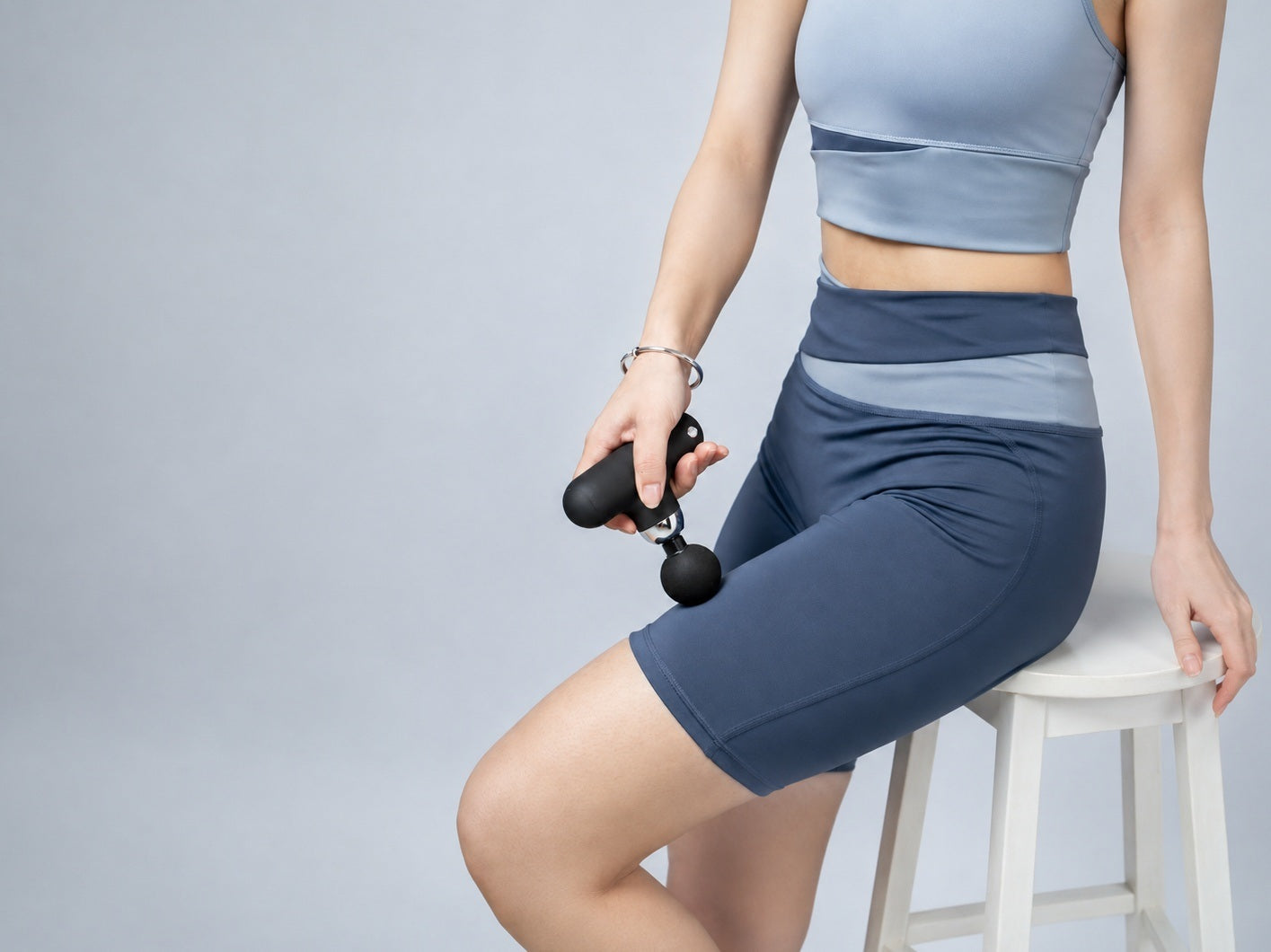
A percussion massager is a reasonable thing to keep near a desk. It takes a minute rather than a routine, and the upper back and shoulders is where most people instinctively reach.
The way it is generally used on that area is brief and moving — passing over the muscle rather than parking on one spot. The 17Well mini massage gun manual sets out the limits plainly: no more than one to two minutes on any single area, and not directly over bone, not over the spine, not over the cervical vertebrae, and not on the face.
It also lists conditions where the device should not be used at all. Among them: cancer, acute fractures, metal implants at a fracture site, vein thrombosis, varicose veins, high blood pressure, kidney stones, acute inflammation, and use near the abdomen during pregnancy. If any of those apply to you, that is a question for a doctor rather than a product page. The guide to using a massage gun walks through the technique itself.
What it will not do is offset the sitting. A massage gun changes how a muscle feels for a while. Changing position is what changes the day.
When to skip the stretches and talk to someone
Some things sit outside what desk stretches can address, and spotting them early beats working through them.
The American Academy of Orthopaedic Surgeons' guidance on when neck pain needs medical care points at neck pain that is continuous and persistent, that is severe, that comes with pain or numbness radiating down the arms or legs, or that arrives alongside headaches, numbness, tingling or weakness.
Two situations call for immediate care rather than an appointment: severe neck pain following an injury such as a car accident, a fall or a diving accident, and radiating pain or numbness in the arms or legs that comes with weakness.
One warning sign is easy to miss because it does not feel like a neck problem at all — a change in fine motor skills. Handwriting that looks different, trouble with buttons, dropping keys and cups. Worth raising with a doctor even when the neck itself feels unremarkable.
The rough line for everything else: stiffness that loosens with movement and returns the next day is ordinary. Stiffness that does neither is worth a conversation.
Setting up a desk you did not plan to have
Most desk setup advice assumes a desk. It pictures an adjustable chair, a monitor arm, a room that exists for working in. Plenty of people are at a kitchen table, on a sofa, on a bed, or at a small desk bought in a hurry and never revisited.
That constraint is worth designing around rather than apologizing for. Three things are adjustable almost anywhere, and between them they cover most of what matters.
Screen height. The top of the screen sitting roughly at eye level keeps your head from drifting forward, which is most of what the back of the neck is objecting to. A stack of books under a laptop does this as well as anything sold for the purpose.
Forearm support. Arms unsupported all day means the shoulders carry their weight all day. A table at the right height does it, and so does sliding the chair in far enough that your forearms rest on the edge.
Feet on the floor. If they dangle, you will find something else to brace against, usually higher up. A box or a lower chair solves it.
Standing desks are not quite the answer people hope for. A full day standing brings its own complaints — legs, feet, lower back — and swapping one fixed position for another fixed position mostly moves the problem around. What helps is the changing, not the standing.
There is no single correct desk setup. The one you will actually keep using beats the one that scores better on paper.
Common questions about stretching when you sit all day
How often should you stretch if you sit all day?
Every sixty to ninety minutes is the pattern worth aiming at, and the bar is lower than it sounds — the point is standing up, not completing the routine. If your calendar makes that impossible, one deliberate break each half-day plus the seated moves still does something.
What causes neck and shoulder tension from desk work?
Mostly holding one position for a long time, rather than holding a wrong one. Posture gets most of the blame, though it matters less than how long a position is held — textbook posture held for four hours gets stiff too.
How do you stop your neck and shoulders getting stiff when working from home?
Much the same way as anywhere else, with one addition: replace the interruptions the office used to supply. No commute and no walk to a meeting room means the sitting runs unbroken unless something breaks it. Pinning a break to an event that already happens works better than an alarm.
Can you use a massage gun on your neck?
The 17Well manual is specific here — not directly over the cervical vertebrae, not over the spine and not over bone, which rules out the bony line down the middle. It also caps any single area at one to two minutes. For where the device is meant to be used and how, check the guide linked above rather than this page.
Is standing all day better than sitting?
Not really. It substitutes one fixed position for another, and standing brings its own complaints. If you can alternate, changing every half hour or so is more useful than picking a side.
How long before sitting feels less stiff?
There is no fixed answer, and anyone quoting one is guessing. Some people notice a difference after a single break; for others it is weeks of doing it regularly.
One thing to start with
If the whole routine feels like too much, start smaller than it. Do the three seated moves once today, at whatever hour you happen to read this. Getting up is the habit that carries the rest — the five minutes are just what makes getting up worth doing.
If you are weighing up whether a percussion massager belongs on your desk, a compact massage gun made for use at home is the portable end of that category, at roughly 230 grams. It is a small addition to the routine above, not a substitute for it.
This is general information, not medical advice.


댓글 남기기
이 사이트는 hCaptcha에 의해 보호되며, hCaptcha의 개인 정보 보호 정책 과 서비스 약관 이 적용됩니다.