




A leg can feel sore after a hard workout, a long shift, or hours of travel, but that does not make every tender spot a target. The calf has broad muscle to work on. The ankle is a joint. The shin and heel are mostly exposed bone. The Achilles tendon and top of the foot are not places to hammer with percussion.
That distinction matters more than choosing the highest speed. For healthy post-activity muscle soreness, begin on relaxed muscle, use the lowest comfortable setting, let the device provide the pressure, and keep the head moving. The sensation should feel tolerable and controlled—not sharp, electric, numbing, or progressively more painful.
If you searched for a mini massage gun for calves, feet and sore legs, use the route below as a conservative starting framework rather than a treatment plan.
First decide whether this is ordinary muscle soreness
A massage gun is a wellness tool for healthy muscle tissue. It is not a way to diagnose a painful calf or test whether an injury is serious.
Skip the session if soreness followed a sudden pull, twist, fall, or direct impact. Do not use percussion over broken or irritated skin, a fresh bruise, visible swelling, or an area that is hot and red. Unexplained symptoms in one leg—especially swelling, warmth, redness, or unusual tenderness—need medical assessment rather than massage. Stop and seek urgent care for chest pain, trouble breathing, faintness, or coughing blood.
Ask a qualified clinician before use if you have reduced sensation, a circulation or clotting concern, osteoporosis, diabetes, a recent operation, or take medication that changes bleeding or sensation. You need reliable feedback from the area to judge pressure safely.
Hospital for Special Surgery advises keeping percussion on muscles rather than bones, nerves, or joints, and stopping if the skin becomes painful, red, or irritated. Its massage-gun safety guidance is a useful boundary when an area feels more concerning than simply tired.
Stop the pass when the signal changes. Mild vibration or a “worked-on” feeling can be expected. Sharp pain, tingling, numbness, throbbing, skin irritation, or increasing tenderness means stop—not increase the speed.
Set up one gentle baseline
Sit or lie down so the target leg can relax. A flexed calf or braced thigh is harder to read and may tempt you to press harder.
Choose the broadest, softest attachment supplied for general muscle use, unless your product instructions say otherwise. Attachment shapes are not standardized across brands, so do not assume a pointed head is appropriate just because it can reach a small spot. Start at the lowest speed.
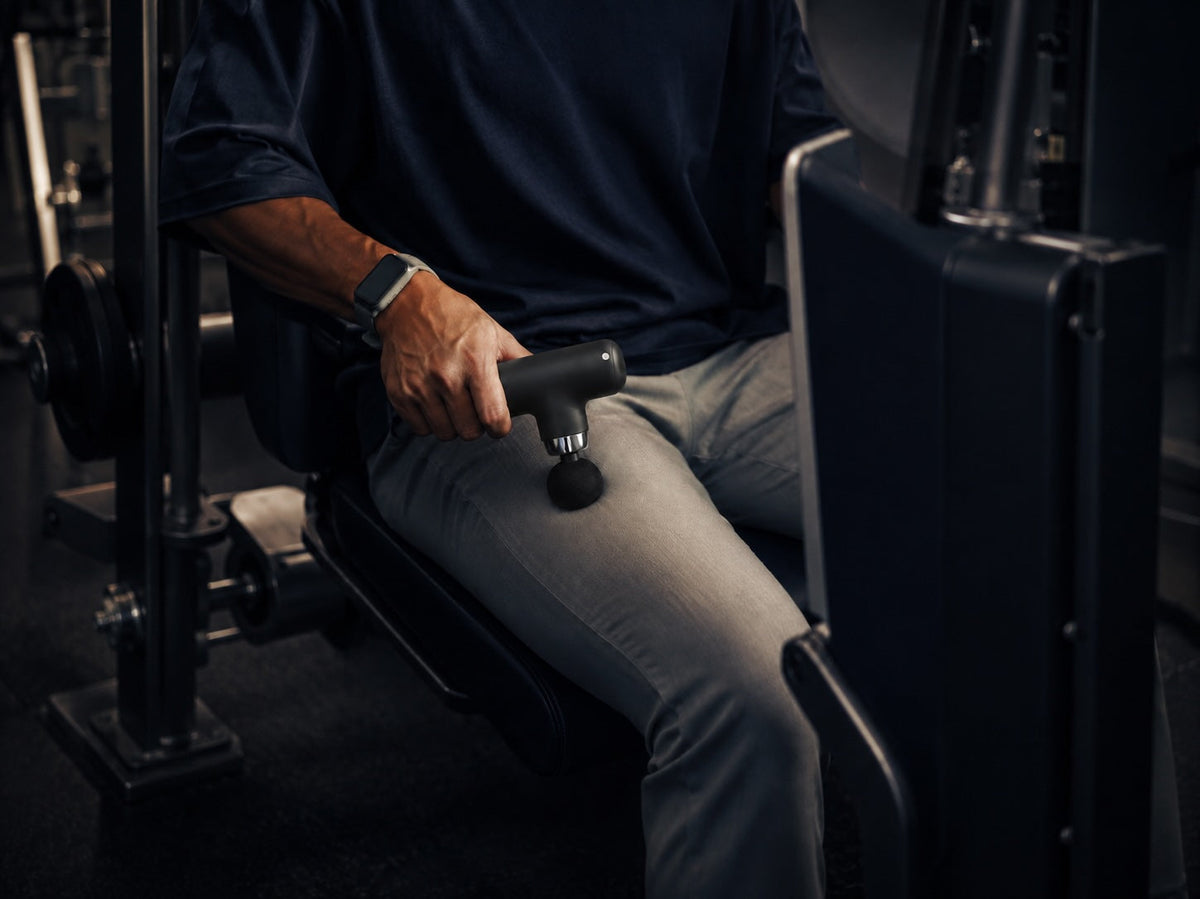
Turn the device on before it touches your skin. Rest the head lightly on the muscle without leaning your bodyweight into it, then glide at roughly an inch or two per second. Clothing is fine if it helps the head move without catching; avoid thick seams and check the skin afterward.
Make one short pass before deciding whether to continue. Ten to 20 seconds over a small region is enough to learn how it responds. If it feels neutral or pleasantly easier, make another pass. If it feels worse, move away or end the session.
Follow the muscle map from thigh to foot
Working from larger, better-padded muscles toward the smaller structures of the foot makes it easier to control the device. You also may discover that foot tension feels different after the calf has relaxed, so direct sole work is not always necessary.
| Zone | Where the head can travel | Areas to avoid | A practical first pass |
|---|---|---|---|
| Front and outer thigh | Broad quadriceps and outer hip-side muscle | Kneecap, hip bone, groin, and the bony outside of the knee | Slow sweeps along the muscle, stopping well above the knee |
| Back of thigh | Broad hamstring muscle while relaxed | Sit bone, crease behind the knee, bruised or sharply painful spots | Light passes through the middle of the muscle |
| Calf | Fleshy inner and outer calf | Shin bone, ankle bones, back of knee, and Achilles tendon | Sweep between just below the knee and above the ankle |
| Foot sole | Only a soft, padded area if your instructions allow it | Heel bone, toes, top of foot, ankle joint, and sharply tender points | Lowest speed, feather-light contact, very brief movement |
Calves: sweep the muscle, not the borders
Rest the lower leg on a chair, bed, or the opposite knee. Place the head on the thickest part of the calf, several inches below the crease behind the knee. Glide down the inner half of the calf, stop before the muscle narrows into the Achilles tendon, then return along the outer half.
Do not run the device up the shin bone or into the hollow behind the knee. Avoid parking on a “knot.” If a spot feels unusually sensitive, reduce pressure and make a wider loop around it. A stubborn point is not proof that the device needs more force.
Research gives a reason to keep expectations modest. In one small study of 16 healthy men, an investigator-applied five-minute calf protocol increased ankle dorsiflexion by 5.4 degrees immediately afterward without reducing measured strength. That acute calf study does not show that every device, duration, or user will get the same result—and it does not prove faster recovery or injury prevention. A useful home goal is simply that normal ankle movement feels no worse, and perhaps a little easier, after a brief pass.
Feet: use percussion sparingly—or not at all
The foot has little padding over many bones and joints. That makes direct percussion less forgiving than calf work. Begin by treating the calf, then stand and take a few easy steps. If the foot already feels more comfortable, stop there.
If your device instructions explicitly permit use on the sole, sit with the foot relaxed and supported. Use the lowest speed and the lightest contact on the soft central portion of the sole. Keep moving and stop well before the heel, toes, and bony edges. Do not use the gun on the top of the foot or around the ankle.
A massage ball rolled gently under the foot gives you finer pressure control and may be a better choice for the arch. More importantly, recurring morning heel pain, burning, numbness, or pain that changes your gait is not a reason to intensify percussion; it is a reason to get the problem assessed.
Thighs: cover broad muscle without chasing soreness
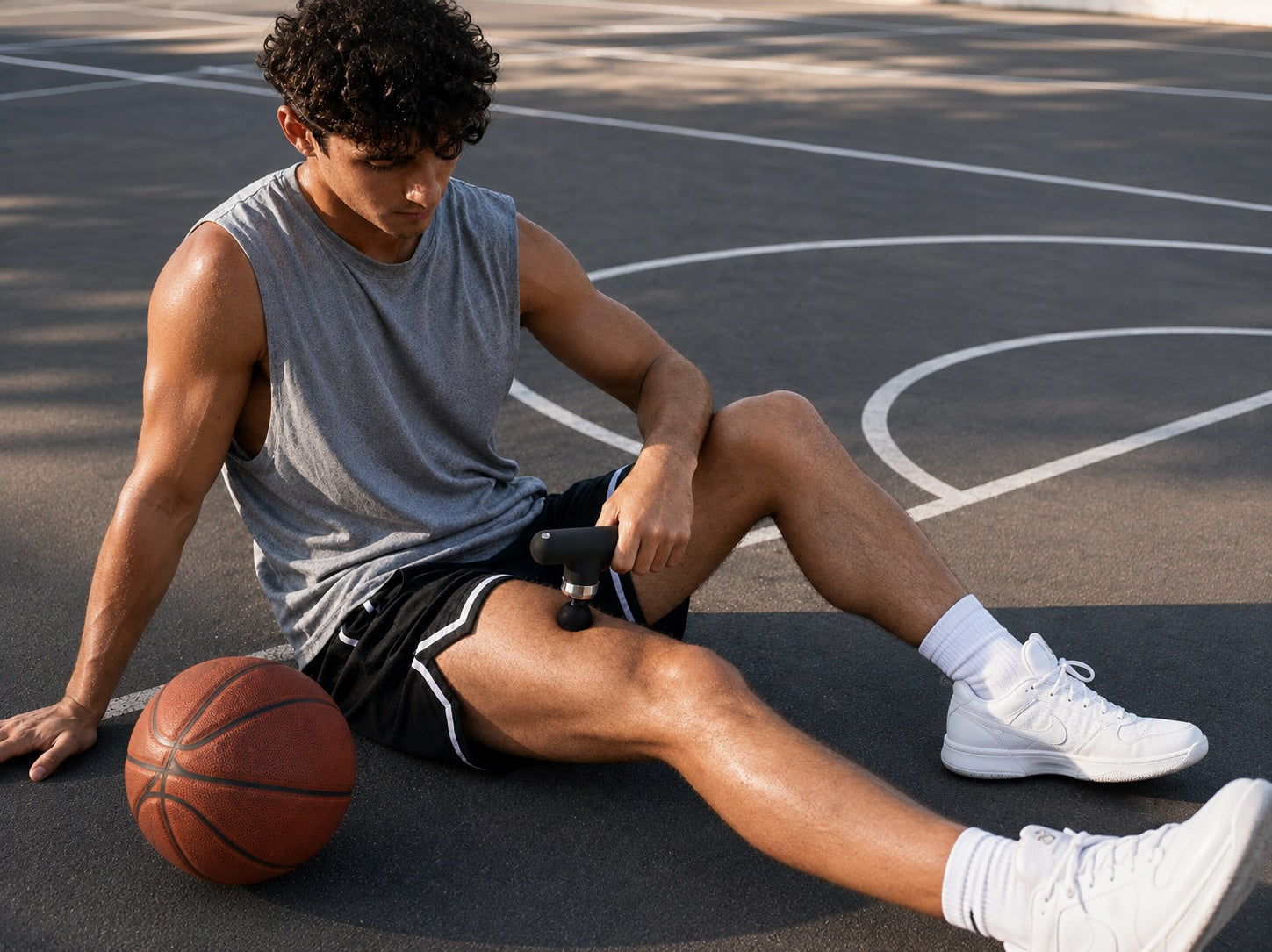
For general leg-day fatigue, use long passes through the front, outer, and back portions of the thigh. Work one surface at a time so you can keep the muscle relaxed. Stop above the kneecap and stay away from the groin, hip bones, and crease behind the knee.
The goal is coverage, not excavation. On a broad thigh, a mini device may require more passes than a full-size tool, but pressing harder to compensate defeats the advantage of precise control. If your hand starts squeezing the handle or the muscle starts bracing, pause.
Let your response set the dose
There is no universal minute count for every body, device, or workout. Expert guidance often uses short passes, while studies commonly test tightly controlled protocols that are longer than a beginner needs. Those study durations should not be copied as a home prescription.
For a first session, spend about 10 to 20 seconds learning each small region and keep the total on one muscle group well under two minutes. Move continuously. Recheck the skin and take a few unforced steps or ankle circles after each zone.
Use the next response to decide what happens:
- Movement feels the same or easier: end the pass while it still feels comfortable. More is not automatically better.
- The area feels more tender: stop for the day. Next time, reduce speed, contact pressure, or duration.
- Symptoms are sharp, spreading, numb, or unexplained: do not repeat the routine. Seek qualified advice.
Pre-activity, keep the pass brief and follow it with an active warm-up. After activity, treat it as an optional comfort step alongside food, fluids, sleep, and appropriate easy movement—not as proof that the muscle has recovered.
Make sure a mini device fits the routine you will repeat
For calves and thighs, useful controls are a low starting speed, a broad attachment, and a handle you can guide without bracing. For feet, fine pressure control matters more than maximum intensity. A compact tool makes sense when easy storage and one-handed placement will help you use it consistently; it is less suitable if you want high-force work or need help reaching an area safely.
The current 17Well Mini Massage Gun listing specifies four speed levels, up to 4,000 impacts per minute, four interchangeable heads, USB recharging, and an official operating-noise range of 25–45 dB. 17Well also lists legs, calves, and plantar fascia among its intended areas, although direct foot use should still follow the product instructions and the conservative placement rules above.
If those controls match how you plan to use the device, buy the 17Well Mini Massage Gun and start with its lowest setting on healthy muscle—not the most painful spot.
FAQ
Can I use a mini massage gun on my calves every day?
Daily use may be comfortable for some people, but frequency is less important than tissue response. Keep sessions brief and light, and skip the next session if the calf is more tender, bruised, irritated, or painful afterward. If soreness persists or has no clear cause, arrange an assessment instead of defaulting to daily percussion.
Can I use a massage gun on the bottom of my foot?
Only if the device instructions allow it, and then use the lowest speed with feather-light, moving contact on a soft, padded part of the sole. Avoid the heel, toes, bony edges, top of the foot, and ankle. A massage ball offers finer control and may be the better option.
Should I use a massage gun when my legs are sore after a workout?
You can try a short, gentle pass on healthy muscle when the soreness is familiar and clearly linked to exercise. Stop if it increases tenderness or changes your movement. Do not use it over swelling, a fresh injury, sharp pain, or unexplained one-sided symptoms.
What speed should I use on calves and feet?
Start at the lowest speed. Increase only if the contact remains comfortable and you can keep the muscle relaxed without adding hand pressure. Feet generally call for less intensity than calves or thighs because many bones and joints sit close to the surface.
Why did a massage gun leave my calf more sore?
The speed, pressure, or duration may have been too high, or the area may not have been suitable for percussion. Stop until the added tenderness settles. If there is bruising, swelling, warmth, redness, numbness, sharp pain, or worsening symptoms, seek qualified medical advice.

댓글 남기기
이 사이트는 hCaptcha에 의해 보호되며, hCaptcha의 개인 정보 보호 정책 과 서비스 약관 이 적용됩니다.