



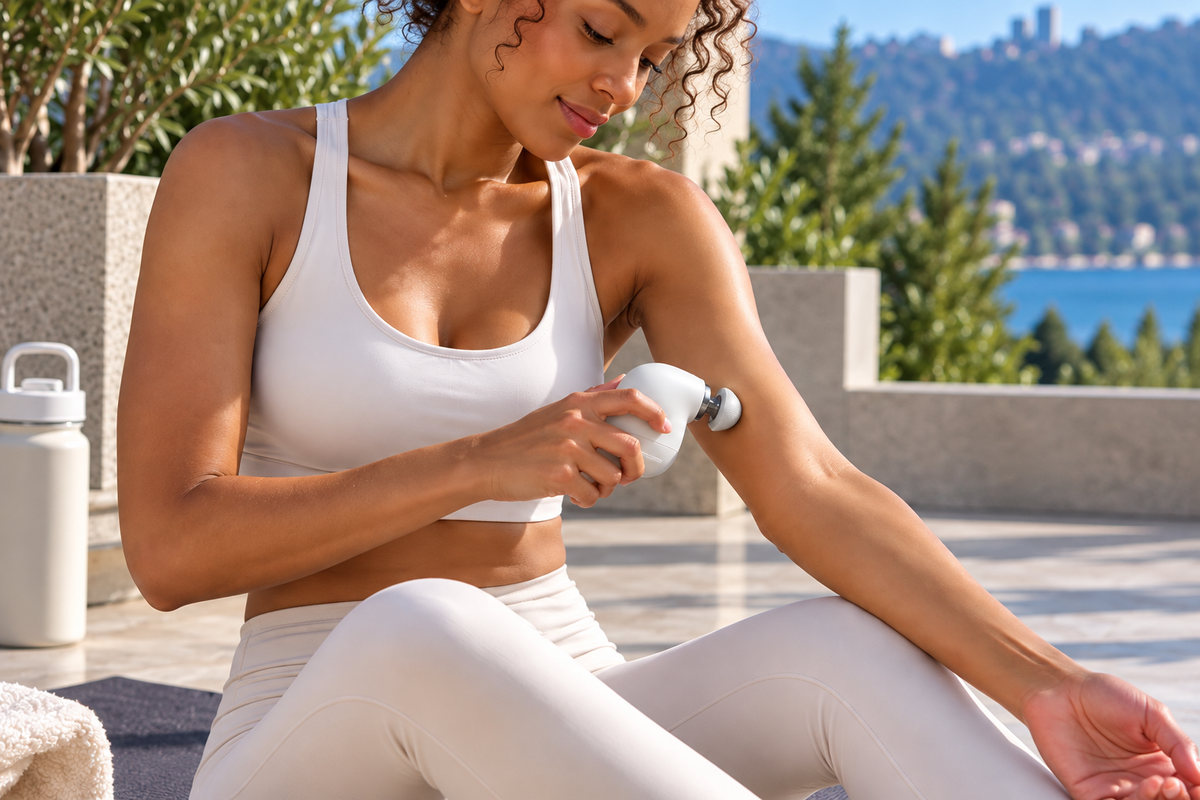
You've just finished a workout and settled onto the couch, ready to relax. You reach for your massage gun, switch it on, and suddenly your quiet evening has a buzzing soundtrack.
Sound familiar?
A portable percussion massager can be convenient for everyday muscle care, but noise is something worth considering—especially if you live with roommates, enjoy watching TV while unwinding, or prefer a peaceful evening.
So, how loud is a massage gun? The answer depends on the model, speed, and how its noise is measured. Let's make sense of the numbers and what they mean in everyday life.
How Loud Are Portable Percussion Massagers, Really?
There's no single massage gun noise level that applies to every device. Some models produce a relatively soft hum, while others become noticeably louder at higher speeds.
In its 2026 massage gun review, independent testing site TechGearLab measured 11 devices at different speeds and operating pressures. Here are four examples:
| Massage Gun | Lowest Measured Level | Highest Measured Level |
|---|---|---|
| Bob and Brad Q2 Mini | 41.5–50.8 dBA | Third-party measurement |
| Theragun Mini | 42.7–53.3 dBA | Third-party measurement |
| Ekrin Athletics Bantam | 47.8–59.1 dBA | Third-party measurement |
| Theragun Prime | 52.8–61.1 dBA | Third-party measurement |
| 17Well EM2 Mini Massage Gun | ≤45 dB | Manufacturer-reported specification |
Source: TechGearLab, The Best Massage Guns of 2026. These are third-party measurements under the reviewer's test conditions, not universal specifications or 17Well EM2 test results.
That's quite a difference between devices designed for similar purposes.
But unless you happen to carry a sound meter around, what does 50 dBA actually sound like?
What Do 40, 45, 50, and 60 Decibels Sound Like?
Everyday Sounds That Put Decibels Into Perspective
Decibels can seem abstract until you compare them with sounds you already know.
| Approximate Sound Level | Everyday Reference | How to Think About It |
|---|---|---|
| 30 dB | A soft whisper | Very faint in a quiet setting |
| 40 dB | A refrigerator humming | A gentle background sound |
| 45 dB | Between common 40 and 50 dB reference levels | May be noticeable in a quiet room |
| 50–60 dB | A quiet office | Everyday background activity |
| 60 dB | Normal conversation | A clearly noticeable sound level |
References: CDC everyday sound examples and NYC Department of Health sound-level guidance. These comparisons are approximate; actual levels vary with distance and environment.
For example, 41.5 dBA is close in measured level to a commonly cited 40 dB refrigerator hum. That doesn't mean a massage gun will sound like your refrigerator, though. One makes a steady hum; the other produces a rhythmic mechanical buzz.
Why a 10 dB Difference Matters More Than You Think
The decibel scale isn't linear. According to the National Institute on Deafness and Other Communication Disorders, a 10 dB increase represents ten times the sound intensity and is often perceived as roughly twice as loud.
You'll also see dBA in product reviews. This is an A-weighted measurement that accounts for how human hearing responds to different sound frequencies.
The takeaway? A difference between 40 and 50 dBA can be more meaningful than those numbers initially suggest.
Why Can Two Massage Guns With Similar Noise Ratings Sound So Different?
The Difference Between a Steady Hum and a Repetitive Buzz
Think about a refrigerator running in the background. After a while, you might barely notice it.
A handheld percussion massager, however, creates repeated mechanical pulses. Depending on the device, its buzzing or rattling may attract more attention than a steady sound at a similar measured level.
That's why two massage guns with comparable decibel ratings can still feel different to use.
Speed, Pressure, and the Way You Use It
Your massage gun might also sound different once you start using it.
Changing speed settings can alter motor noise, while pressing the attachment against a muscle changes the device's operating load. Attachments and vibration can also influence what you hear.
Measurement distance matters, too. A reading taken close to the motor isn't directly comparable with one recorded farther away.
And if your device suddenly starts making unusual rattling sounds, stop using it and check the attachment and manufacturer's instructions before continuing.
Is a Portable Percussion Massager Quiet Enough for Home Use?
Watching TV, Sharing a Room, or Recovering at Night
Picture three situations: you're watching a show, your roommate is reading nearby, or someone in the next room is trying to sleep.
The same massage gun might seem perfectly acceptable in one setting and distracting in another.
Background noise, operating speed, distance, and personal sensitivity all make a difference. There's no universal decibel threshold that guarantees a device won't disturb someone.
What to Check Beyond an “Ultra-Quiet” Label
When shopping for a quiet massage gun, look beyond marketing claims.
Does the manufacturer explain how its noise rating was measured? Is the figure based on the lowest speed or actual use? Can you find a video demonstrating the device at different settings?
These details can help you make a more informed decision than a single “ultra-quiet” label.
Where Does the 17Well EM2's ≤45 dB Rating Fit In?
The 17Well EM2 Mini Massage Gun has a manufacturer-reported noise specification of 45 dB or less.
Looking at the everyday sound references above, 45 dB sits between the commonly cited levels of a refrigerator hum and a quiet office. This provides a useful point of reference, particularly if you're considering a compact massage gun for home use.
However, the EM2 figure is a published product specification, not an independent measurement presented in this article. Its measurement conditions have not been established here, and it shouldn't be directly ranked against TechGearLab's dBA results without comparable testing.
Noise is only one consideration, but it's worth thinking about alongside portability, comfort, and how you plan to use your recovery tools.
If you're exploring compact options, you can learn more about the 17Well EM2 Mini Massage Gun.
FAQs About Portable Percussion Massager Noise
Are Mini Massage Guns Always Quieter Than Full-Size Models?
Not necessarily. A smaller design doesn't automatically guarantee quieter operation. Motor construction, speed settings, and vibration characteristics all influence noise.
Is a 45 dB Massage Gun Considered Quiet?
A measured level around 45 dB is relatively modest compared with ordinary conversation. Still, whether it feels quiet depends on the sound's character, surrounding environment, and measurement conditions.
Why Is My Massage Gun Suddenly Making More Noise?
An improperly fitted attachment or a mechanical issue may cause unexpected noise. If you notice new rattling, grinding, excessive vibration, or overheating, stop using the device and follow the manufacturer's troubleshooting guidance.
A quieter recovery routine isn't just about chasing the lowest decibel number. A portable percussion massager's real-world sound depends on how it's built, how you use it, and where you're using it.
Compare noise ratings when the testing conditions are clear, listen to actual-use demonstrations when available, and choose a device that fits your everyday routine—not just its product description.


Leave a comment
This site is protected by hCaptcha and the hCaptcha Privacy Policy and Terms of Service apply.